
Research Article


-
S. R. Paige, M. Stellefson, and B. H. Chaney, “Understanding e-Health literacy among nursing students”, JMIR Nursing, Vol. 1, No. 1, e2, 2017.
-
신희진, 전재희, “디지털리터러시, 인터넷건강정보에 대한 태도, e-헬스리터러시가 성인의 건강증진행동에 미치는 영향”, 한국성인간호학회지, 제35권 제4호, pp. 367-378, 2023.
-
이은경, 최미영, “간호대학생의 셀프리더십, 학업적 자기효능감 및 진로결정수준의 관계”, 한국간호교육학회지, 제26권 제3호, pp. 314-324, 2020.
-
신현희, 장수현, “간호대학생의 긍정심리자본, 회복탄력성이 대학생의 적응에 미치는 영향”, 한국융합학회논문지, 제13권 제2호, pp. 321-329, 2022.
-
김혜옥, 남문희, “간호대학생의 인성, 회복탄력성이 전공만족도에 미치는 영향”, 간호행정학회지, 제24권 제4호, pp. 298-306, 2018.
-
황선아, “간호대학생의 전공만족도, 학업적 자기효능감 및 임상실습 스트레스가 학교생활소진에 미치는 영향”, 한국간호시뮬레이션학회지, 제9권 제2호, pp. 73-85, 2021.
-
신승호, 이정원, 김창태, “간호대학생의 전공 만족도가 전공 몰입에 미치는 영향”, 한국기술산학기술학회논문지, 제21권 제7호, pp. 136-145, 2020.
-
A. Haleem, M. Javaid, M. A. Qadri, and R. Suman, “Understanding the role of digital technologies in education: A review”, Sustainable Operations and Computers, Vol. 3, pp. 275-285, 2022.
-
Z. S. Li, and F. Hasson, “Resilience, stress, and psychological well-being in nursing students: A systematic review”, Nurse Education Today, Vol. 90, 104440, 2020.
-
R. Van der Vaart, and C. Drossaert, “Development of the Digital Health Literacy Instrument (DHLI): Measuring a broad spectrum of health 1.0 and health 2.0 skills”, Journal of Medical Internet Research, Vol. 19, No. 1, e27, 2017.
-
최은진, 김정은, “대학생의 디지털 헬스 리터러시와 건강정보 탐색·평가·활용능력의 관계”, 디지털융합연구, 제20권 제5호, pp. 149-158, 2022.
-
C. C. Manz, The Art of Self-Leadership, Prentice-Hall, 1983.
-
김한성, “셀프리더십이 직무만족에 미치는 영향”, 한국심리학회지: 산업 및 조직, 제16권 제2호, pp. 19-40, 2003.
-
F. Luthans, C. M. Youssef, and B. J. Avolio, “Psychological Capital: Developing the Human Competitive Edge”, Oxford University Press, 2007.
-
임태홍, “한국형 긍정심리자본(K-PCQ) 측정도구의 타당화 연구”, 한국심리학회지: 산업 및 조직, 제27권 제3호, pp. 275-302, 2014.
-
하혜숙, “전문대학생의 학과만족도 측정도구 개발”, 한국간호교육학회지, 제6권 제2호, pp. 239-250, 2000.
-
이동재, “간호대학생의 전공만족도와 진로의식에 관한 연구”, 한국간호교육학회지, 제10권 제2호, pp. 311-320, 2004.
-
C. Norman, and H. Skinner, “eHEALS: The eHealth Literacy Scale”, Journal of Medical Internet Research, Vol. 8, No. 4, e27, 2006.
-
World Health Organization. WHO Global Strategy on Digital Health 2020-2025, WHO Press, 2020.
-
조현정, 김영희, “간호대학생의 셀프리더십이 학업적 자기효능감과 전공만족도에 미치는 영향”, 한국간호교육학회지, 제26권 제1호, pp. 54-63, 2020.
-
박소빈, 정유진, “간호대학생의 긍정심리자본, 전공만족도, 진로결정자기효능감의 관계”, 한국간호교육학회지, 제25권 제4호, pp. 326-334, 2019.
-
김지은, 박은혜, “간호대학생의 긍정심리자본과 학습동기 및 진로결정효능감의 관계”, 간호교육연구, 제23권 제3호, pp. 229-239, 2022.
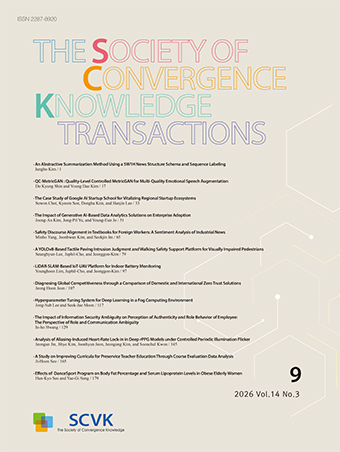
- Publisher :The Society of Convergence Knowledge
- Publisher(Ko) :융복합지식학회
- Journal Title :The Society of Convergence Knowledge Transactions
- Journal Title(Ko) :융복합지식학회논문지
- Volume : 13
- No :4
- Pages :161-171
- DOI :https://doi.org/10.22716/sckt.2025.13.4.014
 The Society of Convergence Knowledge Transactions